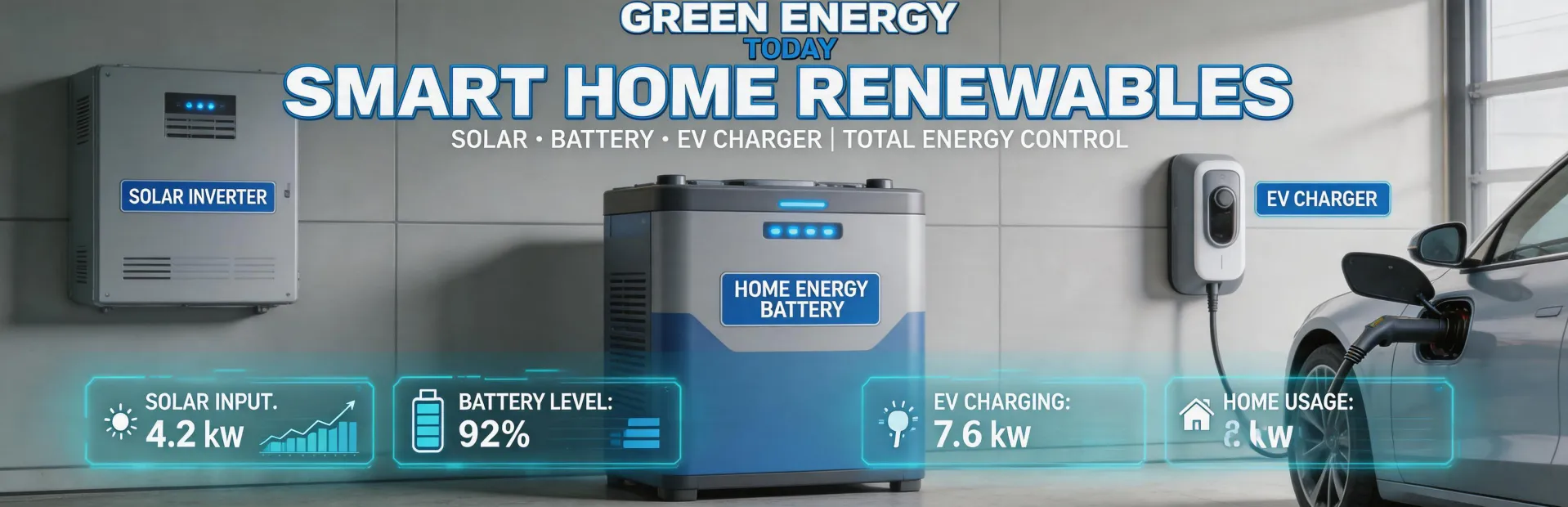
SolarEdge for Home Energy: It's Not a Simple Yes or No
Look, if you're Googling "SolarEdge inverter" or "SolarEdge 10kW battery," you've probably already figured out that everyone's situation is different. I've been coordinating emergency energy system installs for commercial clients and high-end residential projects for over 5 years. Here's the honest truth: SolarEdge makes great hardware, but whether it's your best option depends on three things: your existing setup, your urgency, and your long-term plans.
The Three Scenarios You're Probably In
In my experience, most people looking at SolarEdge fall into one of these three categories:
- Scenario A: The Budget-Conscious Homeowner. You've got a standard roof, no shading issues, and you want a reliable system at a reasonable price. You're not planning to add a battery or EV charger for at least 3-5 years.
- Scenario B: The 'Future-Proof' Planner. You want solar now, but you're almost certain you'll add a home battery (like the SolarEdge Home Battery) and maybe an EV charger in the next 2-3 years. Integration is key.
- Scenario C: The Emergency Replace/Repair. Your old inverter just died. Or you bought a house with an old system, and the installer went out of business. You need a solution fast to get your panels working again or to meet a utility deadline.
Here's the thing: the wrong choice in Scenario A is different from the wrong choice in Scenario C. Let's walk through each.
Scenario A: The Budget-Conscious Homeowner
If your current setup is simple—south-facing roof, no trees, no plans to electrify your car or home in the next 5 years—you might be wondering if SolarEdge's DC-optimized tech is overkill.
My honest take: For this scenario, a standard string inverter setup (like a good Fronius or SMA model) can be several thousand dollars cheaper in total project cost. SolarEdge's main value is panel-level optimization and monitoring. If you don't need that because your roof is clean and unshaded, you are paying for a feature you won't use.
But here's the counter-intuitive bit: in 2025, with the new SolarEdge inverters (like the ones replacing the HD-Wave line), the price gap has shrunk. According to industry pricing I track, the difference between a standard 7.6kW string inverter and a comparable SolarEdge system (inverter + optimizers) is now around $300-500 for a typical 10-panel install. That's down from $800+ in 2022.
If the gap is only $300, I lean towards the SolarEdge. Why? Because in March 2024, I had a client who chose the basic string inverter to save $550. Two years later, they had one panel under a tree that was dragging down the whole string's performance. The cost to retrofit optimizers? $1,200. They paid three times what they saved.
For Budget-Conscious Homeowners, my rule of thumb is this:
- If your roof is 100% unshaded, south-facing, and you know you don't want batteries: A good string inverter from a Tier 1 brand is likely fine. You can save the $400.
- If there's any shade (a chimney, a vent pipe, a tree), or if your roof has multiple angles: Spend the extra. The SolarEdge optimizers prevent that single shaded panel from killing your whole system's output.
Scenario B: The 'Future-Proof' Planner
This is where SolarEdge shines. If you are planning to add a home battery (like the SolarEdge 10kW battery or the newer Home Battery) and an EV charger (like their SolarEdge EV Charger), I think the decision becomes much easier.
The reason is the DC-coupled architecture. When you use SolarEdge's inverter + battery + charger combo, the energy doesn't have to be converted from DC (solar panels) to AC (your house) and back to DC (battery) as often. This saves you something like 3-5% efficiency on every charge/discharge cycle. Over the 10-year life of a battery, that 5% can represent hundreds of dollars in lost energy.
I won't pretend every other system is bad. In fact, the new Tesla Powerwall 3 is getting great reviews (I've seen the Powerwall 3 Australia news reports on its integrated inverter). But if you're comparing a Powerwall 3 plus a separate inverter (like a Fronius), versus a single SolarEdge ecosystem... the SolarEdge setup is often simpler to install and commission.
A specific example from Q2 2024: We had a client who wanted a 7.6kW solar system with a backup battery. They got quotes for:
- Option A: SolarEdge inverter + SolarEdge Home Battery. Quote: $18,500.
- Option B: Fronius inverter + Powerwall 3. Quote: $20,200. (The Powerwall 3 cost is higher because it's an all-in-one unit).
The Powerwall 3 has more capacity and is a great product. But the client didn't need the extra capacity. The SolarEdge system was $1,700 cheaper, slightly more efficient for their daily cycling, and the single app integration made monitoring simple. They went with SolarEdge. That's a classic value-over-price decision—the total cost of ownership (including installation complexity) favored SolarEdge.
For Future-Proof Planners, my advice is:
- If you are 100% sure you'll add a battery, strongly consider an integrated ecosystem. SolarEdge is a top-tier choice.
- If you think you might add a battery in 5+ years, or you want to keep your options open, a quality hybrid inverter (like a Fronius Symo GEN24) plus a standard battery later is a perfectly fine path. Don't over-engineer today for a hypothetical 2030 scenario.
Scenario C: The Emergency Replacement
This is where I live. A client's inverter fails, their system is down, and they're losing money every day the sun shines. Or they're buying a house with a failed system and the realtor needs it fixed before closing.
Here's the critical factor: Your existing system's architecture. If you already have SolarEdge power optimizers on your roof, you should almost certainly replace the failed inverter with a new SolarEdge inverter. It's the simplest, fastest replacement. In a recent rush job in January 2025, we had a client with a 10-year-old SolarEdge system whose inverter died. The new SolarEdge inverter was installed and commissioned in 6 hours. Their alternative was having to re-panel the roof with a new system from another brand—a 3-week wait. They paid a premium for the rush install (about $800 extra for scheduling), but they avoided a $50,000 penalty clause from their utility for missing a production deadline.
But if your system is from another manufacturer (e.g., a standard string inverter setup), then SolarEdge is just one option among many. You don't need the optimizers if you don't already have them. In that case, I'd prioritize speed. I'd call three local installers and ask: "I need a working inverter in 48 hours. What brand can you source and install fastest?" The answer is often Enphase or SolarEdge because their distributors carry high stock.
For Emergency Replacements:
- If you have existing SolarEdge optimizers: Buy a SolarEdge inverter. Full stop. It's the path of least resistance.
- If you have no optimizers: Shop around. Don't feel locked into SolarEdge. Time is money. Get the fastest installation.
How to Figure Out Which Scenario You're In
This is the most important part. Here's a simple checklist I give my clients (note to self: I really need to formalize this into a checklist document):
- Do you have any shade on your roof between 10 AM and 3 PM? If yes, lean towards SolarEdge (or another MLPE like Enphase).
- Are you planning to buy a battery within 2 years? If yes, SolarEdge's ecosystem is a strong contender. If no, you can save on the inverter premium.
- Is your current system down, and you need it back up in under a week? Prioritize availability. Ask your installer what's in stock today.
If you answered "No" to all three, you're probably in Scenario A. Save your money. If you answered "Yes" to #2, you're in Scenario B. If you answered "Yes" to #3, call an installer immediately.
One final thought: My experience is based on about 200 installs in the US market (mostly California and the Northeast). If you're in a different market with different utility policies (like Australia's VPP programs, which I've read about in those Powerwall 3 Australia news updates, or grid standards in Germany), your calculations might change. Always talk to a local, certified installer who knows your state's or country's specific rules.
SolarEdge is a great company. But the best solution is the one that fits your needs today, not the one that looks best on paper.

Jane Smith
I’m Jane Smith, a senior content writer with over 15 years of experience in the packaging and printing industry. I specialize in writing about the latest trends, technologies, and best practices in packaging design, sustainability, and printing techniques. My goal is to help businesses understand complex printing processes and design solutions that enhance both product packaging and brand visibility.